Charles John Huffam Dickens (
; 7 February 1812 – 9 June 1870) was an English writer and social critic. He created some of the world's best-known fictional characters and is regarded as the greatest novelist of the
Victorian era.
[1] His works enjoyed unprecedented popularity during his lifetime, and by the twentieth century critics and scholars had recognised him as a literary genius. His novels and short stories enjoy lasting popularity.
[2][3]
Born in
Portsmouth, Dickens left school to work in a factory when his father was incarcerated in a
debtors' prison. Despite his lack of formal education, he edited a weekly journal for 20 years, wrote 15 novels, five novellas, hundreds of short stories and non-fiction articles, lectured and performed extensively, was an indefatigable letter writer, and campaigned vigorously for children's rights, education, and other social reforms.
Dickens's literary success began with the 1836 serial publication of
The Pickwick Papers. Within a few years he had become an international literary celebrity, famous for his humour, satire, and keen observation of character and society. His novels, most published in monthly or weekly instalments, pioneered the
serial publication of narrative fiction, which became the dominant Victorian mode for novel publication.
[4][5] The instalment format allowed Dickens to evaluate his audience's reaction, and he often modified his plot and character development based on such feedback.
[5] For example, when his wife's
chiropodist expressed distress at the way Miss Mowcher in
David Copperfield seemed to reflect her disabilities, Dickens improved the character with positive features.
[6] His plots were carefully constructed, and he often wove elements from topical events into his narratives.
[7] Masses of the illiterate poor chipped in
ha'pennies to have each new monthly episode read to them, opening up and inspiring a new class of readers.
[8]
Dickens was regarded as the literary colossus of his age.
[9] His 1843 novella,
A Christmas Carol, remains popular and continues to inspire adaptations in every artistic genre.
Oliver Twist and
Great Expectations are also frequently adapted, and, like many of his novels, evoke images of early Victorian London. His 1859 novel,
A Tale of Two Cities, set in London and Paris, is his best-known work of historical fiction. Dickens's creative genius has been praised by fellow writers—from
Leo Tolstoy to
George Orwell and
G. K. Chesterton—for its
realism, comedy, prose style, unique characterisations, and
social criticism. On the other hand,
Oscar Wilde,
Henry James, and
Virginia Woolf complained of a lack of psychological depth, loose writing, and a vein of saccharine sentimentalism. The term
Dickensian is used to describe something that is reminiscent of Dickens and his writings, such as poor social conditions or comically repulsive characters.
[10]
Early years
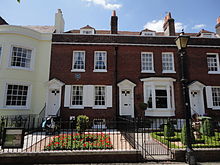
Charles Dickens's birthplace, 393 Commercial Road, Portsmouth
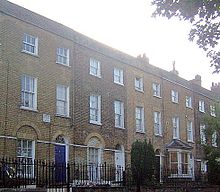
2 Ordnance Terrace,
Chatham, Dickens's home 1817 – May 1821
[11]
Charles John Huffam Dickens was born on 7 February 1812, at 1 Mile End Terrace (now 393 Commercial Road),
Landport in
Portsea Island (
Portsmouth), the second of eight children of
John Dickens (1785–1851) and
Elizabeth Dickens (née Barrow; 1789–1863). His father was a clerk in the Navy Pay Office and was temporarily stationed in the district. He asked Christopher Huffam,
[12] rigger to His Majesty's Navy, gentleman, and head of an established firm, to act as godfather to Charles. Huffam is thought to be the inspiration for Paul Dombey, the owner of a shipping company in Dickens's eponymous
Dombey and Son (1848).
[12]
In January 1815 John Dickens was called back to London, and the family moved to Norfolk Street,
Fitzrovia.
[13] When Charles was four, they relocated to
Sheerness, and thence to
Chatham, Kent, where he spent his formative years until the age of 11. His early life seems to have been idyllic, though he thought himself a "very small and not-over-particularly-taken-care-of boy".
[14]

Illustration by Fred Bernard of Dickens at work in a shoe-blacking factory after his father had been sent to the
Marshalsea, published in the 1892 edition of Forster's
Life of Dickens[18]
This period came to an end in June 1822, when John Dickens was recalled to Navy Pay Office headquarters at
Somerset House, and the family—minus Charles, who stayed behind to finish his final term of work—moved to
Camden Town in London.
[19] The family had left Kent amidst rapidly mounting debts, and, living beyond his means,
[20] John Dickens was forced by his creditors into the
Marshalseadebtors' prison in
Southwark, London in 1824. His wife and youngest children joined him there, as was the practice at the time. Charles, then 12 years old, boarded with Elizabeth Roylance, a family friend, at 112 College Place, Camden Town.
[21] Roylance was "a reduced [impoverished] old lady, long known to our family", whom Dickens later immortalised, "with a few alterations and embellishments", as "Mrs. Pipchin" in
Dombey and Son. Later, he lived in a back-attic in the house of an agent for the
Insolvent Court, Archibald Russell, "a fat, good-natured, kind old gentleman... with a quiet old wife" and lame son, in
Lant Street in Southwark.
[22] They provided the inspiration for the Garlands in
The Old Curiosity Shop.
[23]
On Sundays—with his sister Frances, free from her studies at the
Royal Academy of Music—he spent the day at the Marshalsea.
[24] Dickens later used the prison as a setting in
Little Dorrit. To pay for his board and to help his family, Dickens was forced to leave school and work ten-hour days at Warren's
Blacking Warehouse, on Hungerford Stairs, near the present
Charing Cross railway station, where he earned six
shillings a week pasting labels on pots of boot blacking. The strenuous and often harsh working conditions made a lasting impression on Dickens and later influenced his fiction and essays, becoming the foundation of his interest in the reform of socio-economic and labour conditions, the rigours of which he believed were unfairly borne by the poor. He later wrote that he wondered "how I could have been so easily cast away at such an age".
[25] As he recalled to
John Forster (from
The Life of Charles Dickens):
The blacking-warehouse was the last house on the left-hand side of the way, at old Hungerford Stairs. It was a crazy, tumble-down old house, abutting of course on the river, and literally overrun with rats. Its wainscoted rooms, and its rotten floors and staircase, and the old grey rats swarming down in the cellars, and the sound of their squeaking and scuffling coming up the stairs at all times, and the dirt and decay of the place, rise up visibly before me, as if I were there again. The counting-house was on the first floor, looking over the coal-barges and the river. There was a recess in it, in which I was to sit and work. My work was to cover the pots of paste-blacking; first with a piece of oil-paper, and then with a piece of blue paper; to tie them round with a string; and then to clip the paper close and neat, all round, until it looked as smart as a pot of ointment from an apothecary's shop. When a certain number of grosses of pots had attained this pitch of perfection, I was to paste on each a printed label, and then go on again with more pots. Two or three other boys were kept at similar duty down-stairs on similar wages. One of them came up, in a ragged apron and a paper cap, on the first Monday morning, to show me the trick of using the string and tying the knot. His name was Bob Fagin; and I took the liberty of using his name, long afterwards, in Oliver Twist.
[25]
When the warehouse was moved to Chandos Street in the smart, busy district of
Covent Garden the boys worked in a room in which the window gave onto the street and little audiences gathered and watched them at work—in Dickens biographer
Simon Callow's estimation, the public display was "a new refinement added to his misery".
[26]
A few months after his imprisonment, John Dickens's paternal grandmother, Elizabeth Dickens, died and bequeathed him £450. On the expectation of this legacy, Dickens was released from prison. Under the
Insolvent Debtors Act, Dickens arranged for payment of his creditors, and he and his family left Marshalsea,
[27] for the home of Mrs Roylance.
Charles's mother, Elizabeth Dickens, did not immediately support his removal from the boot-blacking warehouse. This influenced Dickens's view that a father should rule the family, and a mother find her proper sphere inside the home: "I never afterwards forgot, I never shall forget, I never can forget, that my mother was warm for my being sent back". His mother's failure to request his return was a factor in his dissatisfied attitude towards women.
[28]
Righteous indignation stemming from his own situation and the conditions under which
working-class people lived became major themes of his works, and it was this unhappy period in his youth to which he alluded in his favourite, and most
autobiographical, novel,
David Copperfield:
[29] "I had no advice, no counsel, no encouragement, no consolation, no assistance, no support, of any kind, from anyone, that I can call to mind, as I hope to go to heaven!"
[30]
Dickens was eventually sent to the Wellington House Academy in
Camden Town, where he remained until March 1827, having spent about two years there. He did not consider it to be a good school: "Much of the haphazard, desultory teaching, poor discipline punctuated by the headmaster's sadistic brutality, the seedy ushers and general run-down atmosphere, are embodied in Mr. Creakle's Establishment in
David Copperfield."
[30]
Dickens worked at the law office of Ellis and Blackmore, attorneys, of Holborn Court,
Gray's Inn, as a junior
clerk from May 1827 to November 1828. He was a gifted mimic and impersonated those around him: clients, lawyers, and clerks. He went to theatres obsessively—he claimed that for at least three years he went to the theatre every single day. His favourite actor was
Charles Mathews, and Dickens learnt his
monopolylogues, (farces in which Mathews played every character), by heart.
[31] Then, having learned
Gurney'ssystem of shorthand in his spare time, he left to become a freelance reporter. A distant relative, Thomas Charlton, was a freelance reporter at
Doctors' Commons, and Dickens was able to share his box there to report the legal proceedings for nearly four years.
[32][33] This education was to inform works such as
Nicholas Nickleby,
Dombey and Son, and especially
Bleak House—whose vivid portrayal of the machinations and bureaucracy of the legal system did much to enlighten the general public and served as a vehicle for dissemination of Dickens's own views regarding, particularly, the heavy burden on the poor who were forced by circumstances to "go to law".
In 1830, Dickens met his first love, Maria Beadnell, thought to have been the model for the character Dora in
David Copperfield. Maria's parents disapproved of the courtship and ended the relationship by sending her to school in Paris.
[34]
Journalism and early novels
In 1832, at age 20, Dickens was energetic and increasingly self-confident.
[35] He enjoyed mimicry and popular entertainment, lacked a clear, specific sense of what he wanted to become, and yet knew he wanted fame. Drawn to the theatre—he became an early member of the
Garrick[36]—he landed an acting audition at Covent Garden, where the manager
George Bartley and the actor
Charles Kemble were to see him. Dickens prepared meticulously and decided to imitate the comedian Charles Mathews, but ultimately he missed the audition because of a cold. Before another opportunity arose, he had set out on his career as a writer.
[37] In 1833 he submitted his first story, "A Dinner at Poplar Walk", to the London periodical
Monthly Magazine.
[38] William Barrow, a brother of his mother, offered him a job on
The Mirror of Parliament and he worked in the
House of Commons for the first time early in 1832. He rented rooms at
Furnival's Inn and worked as a political journalist, reporting on
Parliamentary debates, and he travelled across Britain to cover election campaigns for the
Morning Chronicle. His journalism, in the form of sketches in periodicals, formed his first collection of pieces, published in 1836:
Sketches by Boz—Boz being a family nickname he employed as a pseudonym for some years.
[39][40] Dickens apparently adopted it from the nickname "Moses", which he had given to his youngest brother
Augustus Dickens, after a character in Oliver Goldsmith's
The Vicar of Wakefield. When pronounced by anyone with a head cold, "Moses" became "Boses"—later shortened to
Boz.
[40][41] Dickens's own name was considered "queer" by a contemporary critic, who wrote in 1849: "Mr Dickens, as if in revenge for his own queer name, does bestow still queerer ones upon his fictitious creations." He contributed to and edited journals throughout his literary career.
[38] In January 1835 the
Morning Chroniclelaunched an evening edition, under the editorship of the
Chronicle's music critic,
George Hogarth. Hogarth invited Dickens to contribute
Street Sketches and Dickens became a regular visitor to his Fulham house, excited by Hogarth's friendship with a hero of his,
Walter Scott, and enjoying the company of Hogarth's three daughters—Georgina, Mary, and nineteen-year-old Catherine.
[42]
Dickens made rapid progress both professionally and socially. He began a friendship with
William Harrison Ainsworth, the author of the highwayman novel
Rookwood (1834), whose bachelor salon in
Harrow Road had become the meeting place for a set that included
Daniel Maclise,
Benjamin Disraeli,
Edward Bulwer-Lytton, and
George Cruikshank. All these became his friends and collaborators, with the exception of Disraeli, and he met his first publisher, John Macrone, at the house.
[43] The success of
Sketches by Boz led to a proposal from publishers
Chapman and Hall for Dickens to supply text to match
Robert Seymour's engraved illustrations in a monthly
letterpress. Seymour committed suicide after the second instalment, and Dickens, who wanted to write a connected series of sketches, hired "
Phiz" to provide the engravings (which were reduced from four to two per instalment) for the story. The resulting story became
The Pickwick Papers, and though the first few episodes were not successful, the introduction of the Cockney character
Sam Weller in the fourth episode (the first to be illustrated by Phiz) marked a sharp climb in its popularity.
[44] The final instalment sold 40,000 copies.
[38]
In November 1836 Dickens accepted the position of editor of
Bentley's Miscellany, a position he held for three years, until he fell out with the owner.
[45] In 1836 as he finished the last instalments of
The Pickwick Papers, he began writing the beginning instalments of
Oliver Twist—writing as many as 90 pages a month—while continuing work on
Bentley's and also writing four plays, the production of which he oversaw.
Oliver Twist,published in 1838, became one of Dickens's better known stories, and was the first Victorian novel with a child
protagonist.
[46]
On 2 April 1836, after a one-year engagement, and between episodes two and three of
The Pickwick Papers, Dickens married
Catherine Thomson Hogarth (1816–1879), the daughter of George Hogarth, editor of the
Evening Chronicle.
[47] After a brief honeymoon in
Chalk in Kent the couple returned to lodgings at
Furnival's Inn.
[48] The first of their
ten children, Charley, was born in January 1837, and a few months later the family set up
home in Bloomsbury at 48 Doughty Street, London, (on which Charles had a three-year lease at £80 a year) from 25 March 1837 until December 1839.
[47][49] Dickens's younger brother
Frederick and Catherine's 17-year-old sister Mary, moved in with them. Dickens became very attached to Mary, and she died in his arms after a brief illness in 1837. Unusually for Dickens, as a consequence of his shock, he stopped working, and he and Kate stayed at a little farm on
Hampstead Heath for a fortnight. Dickens idealised Mary,- the character he fashioned after her,
Rose Maylie, he found he could not now kill, as he had planned, in his fiction
[50] and according to Ackroyd he drew on memories of her for his later descriptions of Little Nell and Florence Dombey.
[51] His grief was so great that he was unable to meet the deadline for the June instalment of
Pickwick Papers and had to cancel the
Oliver Twist instalment that month as well.
[46] The time in Hampstead was the occasion for a growing bond between Dickens and John Forster to develop and Forster soon became his unofficial business manager, and the first to read his work.
[52]

Barnaby Rudge was Dickens's first popular failure—but the character of Dolly Varden, "pretty, witty, sexy, became central to numerous theatrical adaptations"
[53]
In the midst of all his activity during this period there was discontent with his publishers and John Macrone was bought off, while
Richard Bentleysigned over all his rights in
Oliver Twist. Other signs of a certain restlessness and discontent emerge—in
Broadstairs he flirted with Eleanor Picken, the young fiancée of his solicitor's best friend, and one night grabbed her and ran with her down to the sea. He declared they were both to drown there in the "sad sea waves". She finally got free but afterwards kept her distance. In June 1841 he precipitately set out on a two-month tour of Scotland and then, in September 1841, telegraphed Forster that he had decided to go to America.
[56] Master Humphrey's Clock was shut down, though Dickens was still keen on the idea of the weekly magazine, a form he liked, a liking that had begun with his childhood reading of the eighteenth-century magazines
Tatler and
The Spectator.
First visit to the United States
In 1842, Dickens and his wife made their first trip to the United States and Canada. At this time
Georgina Hogarth, another sister of Catherine, joined the Dickens household, now living at Devonshire Terrace,
Marylebone, to care for the young family they had left behind.
[57] She remained with them as housekeeper, organiser, adviser, and friend until Dickens's death in 1870.
[58]

Sketch of Dickens in 1842 during American Tour. Sketch of Dickens's sister Fanny, bottom left
He described his impressions in a
travelogue,
American Notes for General Circulation. Dickens includes in
Notes a powerful condemnation of slavery, which he had attacked as early as
The Pickwick Papers, correlating the emancipation of the poor in England with the abolition of slavery abroad
[59] citing newspaper accounts of runaway slaves disfigured by their masters. From
Richmond, Virginia, Dickens returned to Washington, D.C., and started a trek westward to St. Louis. While there, he expressed a desire to see an American prairie before returning east. A group of 13 men then set out with Dickens to visit Looking Glass Prairie, a trip 30 miles into
Illinois.
During his visit, Dickens spent a month in New York City, giving lectures, raising
the question of international copyright laws and the pirating of his work in America.
[60][61] He persuaded a group of twenty-five writers, headed by
Washington Irving, to sign a petition for him to take to Congress, but the press were generally hostile to this, saying that he should be grateful for his popularity and that it was mercenary to complain about his work being pirated.
[62]
The popularity he gained caused a shift in his self-perception according to critic Kate Flint, who writes the he "found himself a cultural commodity, and its circulation had passed out his control", causing him to become interested in and delve into themes of public and personal personas in the next novels.
[63] She writes that he assumed a role of "influential commentator", publicly and in his fiction, evident in his next few books.
[63]
Soon after his return to England, Dickens began work on the first of his Christmas stories,
A Christmas Carol, written in 1843, which was followed by
The Chimes in 1844 and
The Cricket on the Hearth in 1845. Of these,
A Christmas Carol was most popular and, tapping into an old tradition, did much to promote a renewed enthusiasm for the joys of Christmas in Britain and America.
[64] The seeds for the story became planted in Dickens's mind during a trip to Manchester to witness the conditions of the manufacturing workers there. This, along with scenes he had recently witnessed at the Field Lane
Ragged School, caused Dickens to resolve to "strike a sledge hammer blow" for the poor. As the idea for the story took shape and the writing began in earnest, Dickens became engrossed in the book. He later wrote that as the tale unfolded he "wept and laughed, and wept again" as he "walked about the black streets of London fifteen or twenty miles many a night when all sober folks had gone to bed."
[65]
After living briefly in Italy (1844), Dickens travelled to Switzerland (1846), where he began work on Dombey and Son (1846–48). This and David Copperfield (1849–50) mark a significant artistic break in Dickens's career as his novels became more serious in theme and more carefully planned than his early works.
At about this time he was made aware of a large embezzlement at the firm where his brother, Augustus, worked (John Chapman & Co.). It had been carried out by
Thomas Powell (1809-1887), a clerk, who was on friendly terms with Dickens and who had acted as mentor to Augustus when he started work. Powell was also an author and poet and knew many of the famous writers of the day. After further fraudulent activities, Powell fled to New York and published a book called
The Living Authors of England with a chapter on Charles Dickens, who was not amused by what Powell had written. One item that seemed to have annoyed him was the assertion that he had based the character of Paul Dombey (
Dombey and Son), on Thomas Chapman, one of the principal partners at John Chapman & Co. Dickens immediately fired off a letter to
Lewis Gaylord Clark, editor of the New York literary magazine
The Knickerbocker, saying that Powell was a forger and thief. Clark published the letter in the
New-York Tribune and several other papers picked up on the story. Powell started proceedings to sue these publications and Clark was arrested. Dickens, realising that he had acted in haste, contacted John Chapman & Co. to seek written confirmation of Powell’s guilt. Dickens did receive a reply confirming Powell's embezzlement, but once the directors realised this information may have to be produced in court they refused to make further disclosures. Due to the difficulties of providing evidence in America to support his accusations, Dickens eventually made a private settlement with Powell out of court.
[66]
Philanthropy
In May 1846
Angela Burdett Coutts, heir to the Coutts banking fortune, approached Dickens about setting up a home for the redemption of
fallen women of the working class. Coutts envisioned a home that would replace the punitive regimes of existing institutions with a reformative environment conducive to education and proficiency in domestic household chores. After initially resisting, Dickens eventually founded the home, named "Urania Cottage", in the Lime Grove section of
Shepherds Bush, which he managed for ten years,
[67] setting the house rules, reviewing the accounts and interviewing prospective residents.
[68] Emigration and marriage were central to Dickens's agenda for the women on leaving Urania Cottage, from which it is estimated that about 100 women graduated between 1847 and 1859.
[69]
Religious views
As a young man Dickens expressed a distaste for certain aspects of organized religion. In 1836, in a pamphlet titled
Sunday Under Three Heads, he defended the people's right to pleasure, opposing a plan to prohibit games on Sundays. "Look into your churches- diminished congregations and scanty attendance. People have grown sullen and obstinate, and are becoming disgusted with the faith which condemns them to such a day as this, once in every seven. They display their feeling by staying away [from church]. Turn into the streets [on a Sunday] and mark the rigid gloom that reigns over everything around"
[70]
Dickens honoured the figure of
Christ—though some claim he may have denied his divinity.
[71] Notwithstanding, Dickens has been characterized as a professing Christian.
[72] His son,
Henry Fielding Dickens, described Dickens as someone who "possessed deep religious convictions". Though in the early 1840s Dickens had showed an interest in
Unitarian Christianity, the writer Gary Colledge has asserted that he 'never strayed from his attachment to popular lay
Anglicanism.'
[73] He also wrote a religious work called
The Life of Our Lord (1849), which was a short book about the life of
Jesus Christ, written with the purpose of inculcating his faith to his children and family.
[74][75]
Racism
Dickens has been accused of harboring racist views. He was also known to have vocally supported the harsh crackdown against Black Jamaicans during the
Morant Bay rebellion.
[79]
Middle years
In 1857, Dickens hired professional actresses for the play
The Frozen Deep, written by him and his
protégé,
Wilkie Collins. Dickens fell deeply in love with one of the actresses,
Ellen Ternan, and this passion was to last the rest of his life.
[83] Dickens was 45 and Ternan 18 when he made the decision, which went strongly against Victorian convention, to separate from his wife, Catherine, in 1858—divorce was still unthinkable for someone as famous as he was. When Catherine left, never to see her husband again, she took with her one child, leaving the other children to be raised by her sister Georgina who chose to stay at Gad's Hill.
[58]
During this period, whilst pondering a project to give public readings for his own profit, Dickens was approached through a charitable appeal by
Great Ormond Street Hospital, to help it survive its first major financial crisis. His 'Drooping Buds' essay in
Household Words earlier on 3 April 1852 was considered by the hospital's founders to have been the catalyst for the hospital's success.
[84] Dickens, whose philanthropy was well-known, was asked by his friend, the hospital's founder
Charles West, to preside over the appeal, and he threw himself into the task, heart and soul.
[85] Dickens's public readings secured sufficient funds for an endowment to put the hospital on a sound financial footing—one reading on 9 February 1858 alone raised £3,000.
[86][87][88]
After separating from Catherine,
[89] Dickens undertook a series of hugely popular and remunerative reading tours which, together with his journalism, were to absorb most of his creative energies for the next decade, in which he was to write only two more novels.
[90] His first reading tour, lasting from April 1858 to February 1859, consisted of 129 appearances in 49 different towns throughout England, Scotland and Ireland.
[91] Dickens's continued fascination with the theatrical world was written into the theatre scenes in
Nicholas Nickleby, but more importantly he found an outlet in public readings. In 1866, he undertook a series of public readings in England and Scotland, with more the following year in England and Ireland.
In early September 1860, in a field behind Gad's Hill, Dickens made a bonfire of most of his correspondence—only those letters on business matters were spared. Since Ellen Ternan also destroyed all of his letters to her,
[93] the extent of the affair between the two remains speculative.
[94]In the 1930s, Thomas Wright recounted that Ternan had unburdened herself with a Canon Benham, and gave currency to rumours they had been lovers.
[95] That the two had a son who died in infancy was alleged by Dickens's daughter, Kate Perugini, whom Gladys Storey had interviewed before her death in 1929. Storey published her account in
Dickens and Daughter,
[96][97] but no contemporary evidence exists. On his death, Dickens settled an
annuity on Ternan which made her a financially independent woman.
Claire Tomalin's book,
The Invisible Woman, argues that Ternan lived with Dickens secretly for the last 13 years of his life. The book was subsequently turned into a play,
Little Nell, by
Simon Gray, and
a 2013 film.
Last years
On 9 June 1865, while returning from Paris with Ellen Ternan, Dickens was involved in the
Staplehurst rail crash. The train's first seven carriages plunged off a
cast iron bridge that was under repair. The only
first-class carriage to remain on the track was the one in which Dickens was travelling. Before rescuers arrived, Dickens tended and comforted the wounded and the dying with a flask of brandy and a hat refreshed with water, and saved some lives. Before leaving, he remembered the unfinished manuscript for
Our Mutual Friend, and he returned to his carriage to retrieve it.
[103] Dickens later used this experience as material for his short
ghost story, "
The Signal-Man", in which the central character has a premonition of his own death in a rail crash. He also based the story on several previous
rail accidents, such as the
Clayton Tunnel rail crash of 1861. Dickens managed to avoid an appearance at the
inquest to avoid disclosing that he had been travelling with Ternan and her mother, which would have caused a scandal.
[104]
Second visit to the United States
In the late 1850s Dickens began to contemplate a second visit to the United States, tempted by the money that he believed he could make by extending his reading tour there. The outbreak of the Civil War in America in 1861 delayed his plans. Over two years after the war, Dickens set sail from
Liverpool on 9 November 1867 for his second American reading tour. Landing at
Boston, he devoted the rest of the month to a round of dinners with such notables as
Ralph Waldo Emerson,
Henry Wadsworth Longfellow, and his American publisher,
James Thomas Fields. In early December, the readings began. He performed 76 readings, netting £19,000, from December 1867 to April 1868.
[105] Dickens shuttled between Boston and New York, where he gave 22 readings at
Steinway Hall. Although he had started to suffer from what he called the "true American
catarrh", he kept to a schedule that would have challenged a much younger man, even managing to squeeze in some sleighing in
Central Park.

Poster promoting a reading by Dickens in
Nottinghamdated 4 February 1869, two months before he suffered a mild stroke
During his travels, he saw a significant change in the people and the circumstances of America. His final appearance was at a banquet the American Press held in his honour at
Delmonico's on 18 April, when he promised never to denounce America again. By the end of the tour, the author could hardly manage solid food, subsisting on champagne and eggs beaten in sherry. On 23 April, he boarded his ship to return to Britain, barely escaping a
Federal Tax Lien against the proceeds of his lecture tour.
[106]
Farewell readings
Between 1868 and 1869, Dickens gave a series of "farewell readings" in England, Scotland, and Ireland, beginning on 6 October. He managed, of a contracted 100 readings, to deliver 75 in the provinces, with a further 12 in London.
[105] As he pressed on he was affected by giddiness and fits of paralysis and collapsed on 22 April 1869, at
Preston in Lancashire, and on doctor's advice, the tour was cancelled.
[107] After further provincial readings were cancelled, he began work on his final novel,
The Mystery of Edwin Drood. It was fashionable in the 1860s to 'do the slums' and, in company, Dickens visited
opium dens in
Shadwell, where he witnessed an elderly addict known as "
Laskar Sal", who formed the model for the "Opium Sal" subsequently featured in his mystery novel,
Edwin Drood.
[108]
After Dickens had regained sufficient strength, he arranged, with medical approval, for a final series of readings to partially make up to his sponsors what they had lost due to his illness. There were to be 12 performances, running between 11 January and 15 March 1870, the last at 8:00 pm at
St. James's Hall in London. Although in grave health by this time, he read
A Christmas Carol and
The Trial from Pickwick. On 2 May, he made his last public appearance at a
Royal Academy Banquet in the presence of the
Prince and
Princess of Wales, paying a special tribute on the death of his friend, the illustrator Daniel Maclise.
[109]
Death

Samuel Luke Fildes—
The Empty Chair. Fildes was illustrating "Edwin Drood" at the time of Charles Dickens's death. The engraving shows Dickens's empty chair in his study at
Gads Hill Place. It appeared in the Christmas 1870 edition of the
The Graphic and thousands of prints of it were sold.
[110]

Death certificate of Charles Dickens.
On 8 June 1870, Dickens suffered another stroke at his home after a full day's work on
Edwin Drood. He never regained consciousness, and the next day, five years to the day after the Staplehurst rail crash, he died at Gad's Hill Place. Contrary to his wish to be buried at
Rochester Cathedral "in an inexpensive, unostentatious, and strictly private manner,"
[111] he was laid to rest in the
Poets' Corner of
Westminster Abbey. A printed epitaph circulated at the time of the funeral reads: "To the Memory of Charles Dickens (England's most popular author) who died at his residence, Higham, near Rochester, Kent, 9 June 1870, aged 58 years. He was a sympathiser with the poor, the suffering, and the oppressed; and by his death, one of England's greatest writers is lost to the world."
[112] His last words were: "On the ground", in response to his sister-in-law Georgina's request that he lie down.
[113][nb 1]
On Sunday, 19 June 1870, five days after Dickens was buried in the Abbey, Dean
Arthur Penrhyn Stanley delivered a memorial elegy, lauding "the genial and loving humorist whom we now mourn", for showing by his own example "that even in dealing with the darkest scenes and the most degraded characters, genius could still be clean, and mirth could be innocent." Pointing to the fresh flowers that adorned the novelist's grave, Stanley assured those present that "the spot would thenceforth be a sacred one with both the New World and the Old, as that of the representative of literature, not of this island only, but of all who speak our English tongue."
[114]
In his will, drafted more than a year before his death, Dickens left the care of his £80,000 estate to his longtime colleague John Forster and his "best and truest friend" Georgina Hogarth who, along with Dickens's two sons, also received a tax-free sum of £8,000 (about £800,000 in present terms). Although Dickens and his wife had been separated for several years at the time of his death, he provided her with an annual income of £600 and made her similar allowances in his will. He also bequeathed £19 19s to each servant in his employment at the time of his death.
[115]
Literary style
Dickens preferred the style of the 18th century picaresque novels that he found in abundance on his father's shelves. According to Ackroyd, other than these, perhaps the most important literary influence on him was derived from the fables of
The Arabian Nights.
[116]
His writing style is marked by a profuse linguistic creativity.
[117] Satire, flourishing in his gift for caricature, is his forte. An early reviewer compared him to
Hogarth for his keen practical sense of the ludicrous side of life, though his acclaimed mastery of varieties of class idiom may in fact mirror the conventions of contemporary popular theatre.
[118] Dickens worked intensively on developing arresting names for his characters that would reverberate with associations for his readers, and assist the development of motifs in the storyline, giving what one critic calls an "allegorical impetus" to the novels' meanings.
[117] To cite one of numerous examples, the name Mr. Murdstone in
David Copperfield conjures up twin allusions to "murder" and stony coldness.
[119] His literary style is also a mixture of
fantasy and
realism. His satires of British aristocratic snobbery—he calls one character the "Noble Refrigerator"—are often popular. Comparing orphans to stocks and shares, people to tug boats, or dinner-party guests to furniture are just some of Dickens's acclaimed flights of fancy.
The author worked closely with his illustrators, supplying them with a summary of the work at the outset and thus ensuring that his characters and settings were exactly how he envisioned them. He briefed the illustrator on plans for each month's instalment so that work could begin before he wrote them.
Marcus Stone, illustrator of
Our Mutual Friend, recalled that the author was always "ready to describe down to the minutest details the personal characteristics, and ... life-history of the creations of his fancy."
[120]
Characters
Dickens's biographer
Claire Tomalin regards him as the greatest creator of character in English fiction after
Shakespeare.
[121] Dickensian
characters are amongst the most memorable in English literature, especially so because of their typically whimsical names. The likes of
Ebenezer Scrooge,
Tiny Tim,
Jacob Marley,
Bob Cratchit,
Oliver Twist,
The Artful Dodger,
Fagin,
Bill Sikes,
Pip,
Miss Havisham,
Sydney Carton,
Charles Darnay,
David Copperfield,
Mr. Micawber,
Abel Magwitch,
Daniel Quilp,
Samuel Pickwick,
Wackford Squeers, and
Uriah Heep are so well known as to be part and parcel of British culture, and in some cases have passed into ordinary language: a
scrooge, for example, is a miser.
His characters were often so memorable that they took on a life of their own outside his books. "Gamp" became a slang expression for an umbrella from the character Mrs Gamp, and "Pickwickian", "Pecksniffian", and "Gradgrind" all entered dictionaries due to Dickens's original portraits of such characters who were, respectively,
quixotic, hypocritical, and vapidly factual. Many were drawn from real life: Mrs Nickleby is based on his mother, though she didn't recognise herself in the portrait,
[122] just as Mr Micawber is constructed from aspects of his father's 'rhetorical exuberance':
[123] Harold Skimpole in
Bleak House is based on
James Henry Leigh Hunt: his wife's dwarfish chiropodist recognised herself in Miss Mowcher in
David Copperfield.
[124][125] Perhaps Dickens's impressions on his meeting with Hans Christian Andersen informed the delineation of Uriah Heep.
[126]
Virginia Woolf maintained that "we remodel our psychological geography when we read Dickens" as he produces "characters who exist not in detail, not accurately or exactly, but abundantly in a cluster of wild yet extraordinarily revealing remarks."
[127]
One "character" vividly drawn throughout his novels is London itself. From the
coaching inns on the outskirts of the city to the lower reaches of the
Thames, all aspects of the capital are described over the course of his body of work.
Autobiographical elements

An original illustration by
Phiz from the novel "David Copperfield", widely regarded as Dickens's most autobiographical work
Authors frequently draw their portraits of characters from people they have known in real life.
David Copperfield is regarded by many as a veiled autobiography of Dickens. The scenes of interminable court cases and legal arguments in
Bleak House reflect Dickens's experiences as a law clerk and court reporter, and in particular his direct experience of the law's procedural delay during 1844 when he sued publishers in Chancery for breach of copyright.
[128] Dickens's father was sent to prison for debt, and this became a common theme in many of his books, with the detailed depiction of life in the Marshalsea prison in
Little Dorrit resulting from Dickens's own experiences of the institution.
[129] Lucy Stroughill, a childhood sweetheart, may have affected several of Dickens's portraits of girls such as Little Em'ly in
David Copperfield and Lucie Manette in
A Tale of Two Cities.[130][nb 2] Dickens may have drawn on his childhood experiences, but he was also ashamed of them and would not reveal that this was where he gathered his realistic accounts of squalor. Very few knew the details of his early life until six years after his death, when John Forster published a biography on which Dickens had collaborated. Though Skimpole brutally sends up Leigh Hunt, some critics have detected in his portrait features of Dickens's own character, which he sought to exorcise by self-parody.
[131]
Episodic writing
Most of Dickens's major novels were first written in monthly or weekly instalments in journals such as
Master Humphrey's Clock and
Household Words, later reprinted in book form. These instalments made the stories affordable and accessible, and the series of regular
cliff-hangers made each new episode widely anticipated. When
The Old Curiosity Shop was being serialised, American fans waited at the docks in New York, shouting out to the crew of an incoming ship, "Is little Nell dead?"
[132] Part of Dickens's great talent was to incorporate this episodic writing style but still end up with a coherent novel at the end.

"Charles Dickens as he appears when reading." Wood engraving from
Harper's Weekly, 7 December 1867
Another important impact of Dickens's episodic writing style resulted from his exposure to the opinions of his readers and friends. His friend Forster had a significant hand in reviewing his drafts, an influence that went beyond matters of punctuation. He toned down melodramatic and sensationalist exaggerations, cut long passages (such as the episode of Quilp's drowning in
The Old Curiosity Shop), and made suggestions about plot and character. It was he who suggested that Charley Bates should be redeemed in
Oliver Twist. Dickens had not thought of killing Little Nell, and it was Forster who advised him to entertain this possibility as necessary to his conception of the heroine.
[133]
Dicken's serialisation of his novels was not uncriticised by other authors. In
Robert Louis Stevenson's novel "
The Wrecker", there is a comment by Captain Nares, investigating an abandoned ship: "See! They were writing up the log," said Nares, pointing to the ink-bottle. "Caught napping, as usual. I wonder if there ever was a captain yet that lost a ship with his log-book up to date? He generally has about a month to fill up on a clean break, like Charles Dickens and his serial novels."
Dickens's novels were, among other things, works of
social commentary. He was a fierce critic of the poverty and
social stratification of
Victorian society. In a New York address, he expressed his belief that "Virtue shows quite as well in rags and patches as she does in purple and fine linen".
[134] Dickens's second novel,
Oliver Twist (1839), shocked readers with its images of poverty and crime: it challenged middle class polemics about criminals, making impossible any pretence to ignorance about what poverty entailed.
[135][136]
Literary techniques
Dickens is often described as using idealised characters and highly sentimental scenes to contrast with his
caricatures and the ugly social truths he reveals. The story of Nell Trent in
The Old Curiosity Shop (1841) was received as extraordinarily moving by contemporary readers but viewed as ludicrously sentimental by
Oscar Wilde. "You would need to have a heart of stone", he declared in one of his famous witticisms, "not to laugh at the death of little Nell."
[137] G. K. Chesterton, stated: "It is not the death of little Nell, but the life of little Nell, that I object to", arguing that the maudlin effect of his description of her life owed much to the gregarious nature of Dickens's grief, his "despotic" use of people's feelings to move them to tears in works like this.
[138]
The question as to whether Dickens belongs to the tradition of the
sentimental novel is debatable. Valerie Purton, in her recent
Dickens and the Sentimental Tradition, sees him continuing aspects of this tradition, and argues that his "sentimental scenes and characters [are] as crucial to the overall power of the novels as his darker or comic figures and scenes", and that "
Dombey and Son is [ ... ] Dickens's greatest triumph in the sentimentalist tradition".
[139] The
Encyclopædia Britannica online comments that, despite "patches of emotional excess", such as the reported death of Tiny Tim in
A Christmas Carol (1843), "Dickens cannot really be termed a sentimental novelist".
[140]
In
Oliver Twist Dickens provides readers with an idealised portrait of a boy so inherently and unrealistically good that his values are never subverted by either brutal orphanages or coerced involvement in a gang of young
pickpockets. While later novels also centre on idealised characters (Esther Summerson in
Bleak House and Amy Dorrit in
Little Dorrit), this idealism serves only to highlight Dickens's goal of poignant social commentary. Dickens's fiction, reflecting what he believed to be true of his own life, makes frequent use of coincidence, either for comic effect or to emphasise the idea of providence.
[141] For example, Oliver Twist turns out to be the lost nephew of the upper-class family that rescues him from the dangers of the pickpocket group. Such coincidences are a staple of 18th-century picaresque novels, such as Henry Fielding's
Tom Jones, which Dickens enjoyed reading as a youth.
[142]
Reception
Dickens was the most popular novelist of his time,
[143] and remains one of the best-known and most-read of English authors. His works have never gone
out of print,
[144] and have been adapted continually for the screen since the invention of cinema,
[145] with at least 200 motion pictures and TV adaptations based on Dickens's works documented.
[146]Many of his works were adapted for the stage during his own lifetime, and as early as 1913, a silent film of
The Pickwick Papers was made.
[147] He created some of the world's best-known fictional characters and is regarded as the greatest novelist of the
Victorian era.
[1]
Among fellow writers, Dickens has been both lionised and mocked. Leo Tolstoy, G. K. Chesterton, and
George Orwell praised his realism, comic voice, prose fluency, and genius for satiric caricature, as well as his
passionate advocacy on behalf of children and the poor. Oscar Wilde generally disparaged his depiction of character, while admiring his gift for caricature.
[148] His late contemporary
William Wordsworth, by then
Poet laureate, thought him a "very talkative, vulgar young person", adding he had not read a line of his work; Dickens in return thought Wordsworth "a dreadful Old Ass".
[149] Henry James denied him a premier position, calling him "the greatest of superficial novelists": Dickens failed to endow his characters with psychological depth and the novels, "loose baggy monsters",
[150] betrayed a "cavalier organisation".
[151] Virginia Woolf had a love-hate relationship with his works, finding his novels "mesmerizing" while reproving him for his sentimentalism and a commonplace style.
[152]
A Christmas Carol is most likely his best-known story, with frequent new adaptations. It is also the most-filmed of Dickens's stories, with many versions dating from the early years of cinema.
[153] According to the historian
Ronald Hutton, the current state of the observance of Christmas is largely the result of a mid-Victorian revival of the holiday spearheaded by
A Christmas Carol. Dickens catalysed the emerging Christmas as a family-centred festival of generosity, in contrast to the dwindling community-based and church-centred observations, as new middle-class expectations arose.
[154] Its archetypal figures (Scrooge, Tiny Tim, the Christmas ghosts) entered into Western cultural consciousness. A prominent phrase from the tale, "
Merry Christmas", was popularised following the appearance of the story.
[155] The term Scrooge became a synonym for miser, and his dismissive exclamation
'Bah! Humbug!' likewise gained currency as an idiom.
[156] Novelist
William Makepeace Thackeray called the book "a national benefit, and to every man and woman who reads it a personal kindness".
[153]
At a time when Britain was the major economic and political power of the world, Dickens highlighted the life of the forgotten poor and disadvantaged within society. Through his journalism he campaigned on specific issues—such as
sanitation and the
workhouse—but his fiction probably demonstrated its greatest prowess in changing public opinion in regard to class inequalities. He often depicted the exploitation and oppression of the poor and condemned the public officials and institutions that not only allowed such abuses to exist, but flourished as a result. His most strident indictment of this condition is in
Hard Times (1854), Dickens's only novel-length treatment of the industrial working class. In this work, he uses vitriol and satire to illustrate how this marginalised social stratum was termed "Hands" by the factory owners; that is, not really "people" but rather only appendages of the machines they operated. His writings inspired others, in particular journalists and political figures, to address such problems of class oppression. For example, the prison scenes in
The Pickwick Papers are claimed to have been influential in having the
Fleet Prison shut down.
Karl Marx asserted that Dickens "issued to the world more political and social truths than have been uttered by all the professional politicians, publicists and moralists put together".
[157] George Bernard Shaw even remarked that
Great Expectations was more seditious than Marx's
Das Kapital.
[157] The exceptional popularity of Dickens's novels, even those with socially oppositional themes (
Bleak House, 1853;
Little Dorrit, 1857;
Our Mutual Friend, 1865), not only underscored his almost preternatural ability to create compelling storylines and unforgettable characters, but also ensured that the Victorian public confronted issues of social justice that had commonly been ignored. It has been argued that his technique of flooding his narratives with an 'unruly superfluity of material' that, in the gradual dénouement, yields up an unsuspected order, influenced the organisation of
Charles Darwin's
On the Origin of Species.
[158]
Influence and legacy
Museums and festivals celebrating Dickens's life and works exist in many places with which Dickens was associated, such as the Charles Dickens Birthplace Museum in Portsmouth, the house in which he was born. The original manuscripts of many of his novels, as well as printers' proofs, first editions, and illustrations from the collection of Dickens's friend John Forster are held at the
Victoria and Albert Museum.
[159] Dickens's will stipulated that no memorial be erected in his honour; nonetheless, a life-size bronze statue of Dickens, cast in 1891 by
Francis Edwin Elwell, stands in
Clark Park in the
Spruce Hill neighbourhood of
Philadelphia, Pennsylvania. Another life-size statue of Dickens is located at
Centennial Park, Sydney, Australia.
[160] In 2014, a life-size statue was unveiled near his birthplace in Portsmouth on the 202nd anniversary of his birth; this was supported by the author's great-great grandsons, Ian and
Gerald Dickens.
[161][162]
Notable works
Dickens published more than a dozen major novels, a large number of short stories, including a number of Christmas-themed stories, a handful of plays, and several non-fiction books. Dickens's novels were initially serialised in weekly and monthly magazines, then reprinted in standard book formats.
- The Posthumous Papers of the Pickwick Club (Known as "The Pickwick Papers") (Monthly serial, April 1836 to November 1837)[167]
- The Adventures of Oliver Twist (Monthly serial in Bentley's Miscellany, February 1837 to April 1839)
- The Life and Adventures of Nicholas Nickleby (Monthly serial, April 1838 to October 1839)
- The Old Curiosity Shop (Weekly serial in Master Humphrey's Clock, April 1840 to November 1841)
- Barnaby Rudge: A Tale of the Riots of Eighty (Weekly serial in Master Humphrey's Clock, February to November 1841)
- A Christmas Carol (1843)
- The Life and Adventures of Martin Chuzzlewit (Monthly serial, January 1843 to July 1844)
- Dombey and Son (Monthly serial, October 1846 to April 1848)
- David Copperfield (Monthly serial, May 1849 to November 1850)
- Bleak House (Monthly serial, March 1852 to September 1853)
- Hard Times: For These Times (Weekly serial in Household Words, 1 April 1854, to 12 August 1854)
- Little Dorrit (Monthly serial, December 1855 to June 1857)
- A Tale of Two Cities (Weekly serial in All the Year Round, 30 April 1859, to 26 November 1859)
- Great Expectations (Weekly serial in All the Year Round, 1 December 1860 to 3 August 1861)
- Our Mutual Friend (Monthly serial, May 1864 to November 1865)
References
Footnotes
- Jump up^ A contemporary obituary in The Times, alleged that Dickens's last words were: "Be natural my children. For the writer that is natural has fulfilled all the rules of Art." reprinted from The Times, London, August 1870 in Bidwell 1870, p. 223.
- Jump up^ Slater detects also Ellen Ternan in the portrayal of Lucie Manette.
Notes
- ^ Jump up to:a b Black 2007, p. 735.
- Jump up^ Mazzeno 2008, p. 76.
- Jump up^ Chesterton 2005, pp. 100–126.
- Jump up^ Grossman 2012, p. 54
- ^ Jump up to:a b Lodge 2002, p. 118.
- Jump up^ Ziegler 2007, pp. 46–47.
- Jump up^ Stone 1987, pp. 267–268.
- Jump up^ Hauser 1999, p. 116.
- Jump up^ Cain 2008, p. 1.
- Jump up^ "Oxford Dictionaries – Dickensian". Oxford University Press.
- Jump up^ Simon Callow, Charles Dickens and the Great Theatre of the World, p.9
- ^ Jump up to:a b West, Gilian. "Huffam and Son." Dickensian 95, no. 447 (Spring, 1999): 5–18.
- Jump up^ Charles Dickens and the Great Theatre of the World, Simon Callow, p.5
- Jump up^ Forster 2006, p. 13.
- Jump up^ Simon Callow, Charles Dickens and the Great Theatre of the World, p.7
- Jump up^ Ackroyd 1990, pp. 22–24:29–30.
- Jump up^ Ackroyd 1990, p. 41.
- Jump up^ Schlicke 1999, p. 158.
- Jump up^ Simon Callow, p.13
- Jump up^ Ackroyd 1990, p. 76:'recklessly improvident'.
- Jump up^ Pope-Hennessy 1945, p. 11.
- Jump up^ Forster 2006, p. 27.
- Jump up^ Ackroyd 1990, p. 76.
- Jump up^ Wilson 1972, p. 53.
- ^ Jump up to:a b Forster 2006, pp. 23–24.
- Jump up^ Callow, p.25
- Jump up^ Schlicke 1999, p. 157.
- Jump up^ Wilson 1972, p. 58.
- Jump up^ Cain 2008, p. 91.
- ^ Jump up to:a b Wilson 1972, p. 61.
- Jump up^ Callow, p.34, 36
- Jump up^ Pope-Hennessy 1945, p. 18.
- Jump up^ Wilson 1972, p. 64.
- Jump up^ Davis 1998, p. 23.
- Jump up^ Callow, p.48
- Jump up^ Claire Tomalin, The Invisible Woman, p.7
- Jump up^ Claire Tomalin, the Invisible Woman, p.76
- ^ Jump up to:a b c Patten 2001, pp. 16–18.
- Jump up^ Ackroyd 1990, pp. 174–176.
- ^ Jump up to:a b Glancy 1999, p. 6.
- Jump up^ Van De Linde 1917, p. 75.
- Jump up^ Callow p.54
- Jump up^ Simon Callow, Charles Dickens and the Great Theatre of the World, p.56
- Jump up^ Simon Callow, Charles Dickens and the Great theatre of the World, p.60
- Jump up^ Ackroyd 1990, pp. 201, 278–279.
- ^ Jump up to:a b Smiley 2002, pp. 12–14.
- ^ Jump up to:a b Schlicke 1999, p. 160.
- Jump up^ Ackroyd 1990, pp. 162, 181–182.
- Jump up^ Ackroyd 1990, p. 221.
- Jump up^ Simon Callow, Charles Dickens and the Great Theatre of the World, p.74
- Jump up^ Ackroyd 1990, pp. 225–229:p=227.
- Jump up^ Simon Callow, p.77, 78 'Charles Dickens and the Great Theatre of the World'
- Jump up^ Simon Callow, Charles Dickens and the Great Theatre of the World, p.97
- Jump up^ "Queen Victoria's Journals". RA VIC/MAIN/QVJ (W). 26 December 1838. Retrieved 24 May 2013.
- Jump up^ Schlicke 1999, p. 514.
- Jump up^ Simon Callow, Charles Dickens and the Great Theatre of the World, p 98
- Jump up^ Jones 2004, p. 7
- ^ Jump up to:a b Smith 2001, pp. 10–11.
- Jump up^ Moore 2004, pp. 44–45
- Jump up^ Ackroyd 1990, pp. 345–346.
- Jump up^ Tomalin 2011, p. 127.
- Jump up^ Tomalin 2011, pp. 128–132.
- ^ Jump up to:a b Flint 2001, p. 35.
- Jump up^ Callow 2009, pp. 146–148.
- Jump up^ Schlicke 1999, p. 98.
- Jump up^ Moss, Sidney P.; Moss, Carolyn J. (1996). The Charles Dickens-Thomas Powell Vendetta. Troy New York: The Whitston Publishing Company. pp. 42–125.
- Jump up^ Nayder 2011, p. 148.
- Jump up^ Ackroyd 1990, pp. 249; 530–538; 549–550; 575
- Jump up^ Hartley 2009, pp. ?.
- Jump up^ Simon Callow, Charles Dickens and the Great Theatre of the World p.63sunday under three headsArchived September 25, 2014, at theWayback Machine.
- Jump up^ Simon Callow, 'Charles Dickens'. p.159
- Jump up^ Gary Colledge (2012), God and Charles Dickens: Recovering the Christian Voice of a Classic Author, p. 24.
- Jump up^ Colledge 2009, p. 87.
- Jump up^ Stephen Skelton, Reclaiming 'A Christmas Carol'. CBN
- Jump up^ The Life Of Our Lord
- Jump up^ "Dickens y la religión: "La vida de nuestro Señor" (1846)".
- Jump up^ Sally Ledger, Holly Furneaux, (2011), "Charles Dickens in Context", Cambridge University Press. p. 318. ISBN 0521887003
- Jump up^ Cedric Thomas Watts (1976). "The English novel". Sussex Books. p. 55
- Jump up^ "Marlon James and Charles Dickens: Embrace the art, not the racist artist".The Economist. 20 October 2015. Retrieved 21 October 2015.
- Jump up^ Ackroyd 1990, pp. 628; 634–638.
- Jump up^ Ackroyd 1990, pp. 648; 686–687; 772–773
- Jump up^ Ackroyd 1990, pp. 32:723:750.
- Jump up^ Ackroyd 1990, pp. 788–799.
- Jump up^ Furneaux 2011, pp. 190–191.
- Jump up^ Page 1999, p. 261.
- Jump up^ Jones 2004, pp. 80–81.
- Jump up^ Ackroyd 1990, pp. 801, 804.
- Jump up^ Page 1999, pp. 260–263 for excerpts from the speech.
- Jump up^ Ackroyd 1990, pp. 809–814.
- Jump up^ Sutherland 1990, p. 185.
- Jump up^ Hobsbaum 1998, p. 270.
- Jump up^ Ackroyd 1990, pp. 589–95; 848–852.
- Jump up^ Tomalin 2011, pp. 332.
- Jump up^ Ackroyd 1990, pp. 881–883.
- Jump up^ Ackroyd 1990, pp. 914–917.
- Jump up^ Nisbet 1952, p. 37.
- Jump up^ Tomalin 1992, pp. 142–143.
- Jump up^ Henson 2004, p. 113.
- Jump up^ Ashley Alexander Mallett, The Black Lords of Summer: The Story of the 1868 Aboriginal Tour of England, pp.65–66.
- Jump up^ Australian Dictionary of Biography. Retrieved 29 October 2013
- Jump up^ University of Sydney. Retrieved 29 October 2013
- Jump up^ Sydney Morning Herald, "Dickens of a time", 24 December 2002. Retrieved 29 October 2013
- Jump up^ Ackroyd 1990, pp. 959–961.
- Jump up^ "The Staplehurst Disaster". Retrieved 28 February 2015.
- ^ Jump up to:a b Hobsbaum 1998, p. 271.
- Jump up^ Jackson 1995, p. 333.
- Jump up^ Ackroyd 1990, pp. 1043–1044.
- Jump up^ Foxcroft 2007, p. 53.
- Jump up^ Ackroyd 1990, pp. 1069–1070.
- Jump up^ "Luke Fildes". TheFamousArtists.com.
- Jump up^ Forster 2006, p. 628.
- Jump up^ Hughes 1891, p. 226.
- Jump up^ Ackroyd 1990, pp. 1077–1078.
- Jump up^ Stanley 1870, pp. 144–147:146.
- Jump up^ "John Forster, "The Life of Charles Dickens" (13)".
- Jump up^ Ackroyd 1990, pp. 44–45.
- ^ Jump up to:a b Mee 2010, p. 20.
- Jump up^ Vlock 1998, p. 30.
- Jump up^ Stone 1987, pp. xx–xxi.
- Jump up^ Cohen 1980, p. 206.
- Jump up^ Jones 2012.
- Jump up^ Ziegler 2007, p. 45.
- Jump up^ Hawes 1998, p. 153.
- Jump up^ Ziegler 2007, p. 46.
- Jump up^ Hawes 1998, p. 158.
- Jump up^ Hawes 1998, p. 109.
- Jump up^ Woolf 1986, p. 286.
- Jump up^ Polloczek 1999, p. 133.
- Jump up^ Ackroyd 1990.
- Jump up^ Slater 1983, pp. 43, 47.
- Jump up^ Ackroyd 1990, p. 653.
- Jump up^ Glancy 1999, p. 34.
- Jump up^ Davies 1983, pp. 166–169.
- Jump up^ Ackroyd 1990, p. 345.
- Jump up^ Raina 1986, p. 25.
- Jump up^ Bodenheimer 2011, p. 147.
- Jump up^ Ellmann 1988, p. 441: In conversation with Ada Leverson.
- Jump up^ Chesterton 1911, pp. 54–55.
- Jump up^ London: Anthem Press, 2012, p.xiii, p.123.
- Jump up^ "novel (literature)". Encyclopædia Britannica. Retrieved 7 July 2013.
- Jump up^ Marlow 1994, pp. 149–150.
- Jump up^ Ackroyd 1990, p. 44.
- Jump up^ Trollope 2007, p. 62.
- Jump up^ Swift 2007
- Jump up^ Sasaki 2011, p. 67.
- Jump up^ Morrison 2012.
- Jump up^ Flom, Eric L. (5 March 2009). Silent Film Stars on the Stages of Seattle: A History of Performances by Hollywood Notables. McFarland. p. 119.ISBN 9780786439089.
- Jump up^ Ellmann 1988, pp. 25,359.
- Jump up^ Mackenzie 1870, p. 243.
- Jump up^ Kucich & Sadoff 2006, p. 162.
- Jump up^ Mazzeno 2008, pp. 23–4.
- Jump up^ Mazzeno 2008, p. 67.
- ^ Jump up to:a b Callow 2009, p. 39.
- Jump up^ Hutton 2001, p. 188.
- Jump up^ Cochrane 1996, p. 126.
- Jump up^ Robinson 2005, p. 316.
- ^ Jump up to:a b Kucich & Sadoff 2006, p. 155.
- Jump up^ Atkinson 1990, p. 48, citing Gillian Beer's Darwin's Plots (1983, p.8).
- Jump up^ Jones 2004, p. 104.
- Jump up^ "Down Under with Dickens". Sydney Morning Herald". Retrieved 18 February 2014
- Jump up^ Kennedy, Maev (6 February 2014)."Portsmouth erects Britain's first full-size statue of Charles Dickens". The Guardian. Retrieved 26 February 2014.
- Jump up^ "Charles Dickens statue unveiled in Portsmouth". BBC. Retrieved14 February 2014.
- Jump up^ Werner 2011.
- Jump up^ "BBC – Great Britons – Top 100".Internet Archive. Archived from the original on 4 December 2002. Retrieved 20 April 2013.
- Jump up^ Bloom, Harold. 1994. The Western Canon: The Books and School of the Ages. p. 226. New York: Harcourt Brace.
- Jump up^ The Big Read: Top 100 Books BBCRetrieved 2 April 2011
- Jump up^ Johnson 1969 for the serial publication dates.
Bibliography
- Ackroyd, Peter (1990). Dickens. London: Sinclar-Stevenson. ISBN 1-85619-000-5.
- Atkinson, Paul (1990). The Ethnographic Imagination: Textual Constructions of Reality. London: Routledge. ISBN 978-0-415-01761-9.
- Bidwell, Walter Hilliard, ed. (July–December 1870). "The Eclectic Magazine: Foreign Literature". Eclectic magazine: foreign literature, science and art. New Series (Charles Dickens Obituary) (New York: E.R.Pelton) 12: 222–224.
- Black, Joseph Laurence (2007). "Charles Dickens". In Black, Joseph Laurence. The age of romanticism. The Victorian era. The twentieth century and beyond. The Broadview Anthology of British Literature 2. Broadview Press. pp. 735–743. ISBN 978-1-55111-869-7.
- Bodenheimer, Rosemarie (2011). "London in the Victorian Novel". In Manley, Lawrence. The Cambridge Companion to the Literature of London. Cambridge University Press. pp. 142–159. ISBN 978-0-521-72231-5.
- Cain, Lynn (2008). Dickens, family, authorship: psychoanalytic perspectives on kinship and creativity. Ashgate Publishing. ISBN 978-0-7546-6180-1.
- Callow, Simon (2009). Dickens' Christmas: A Victorian Celebration. Frances Lincoln Ltd.ISBN 978-0-7112-3031-6.
- Chesterton, G. K. (2005) [1906]. Charles Dickens: A Critical Study. Kessinger Publishing.ISBN 978-1-4179-1996-3.
- Chesterton, G. K. (1911). Appreciations and Criticisms of the Works of Charles Dickens. J. M. DentForgotten Books. ISBN 978-1-4400-9125-4.
- Cochrane, Robertson (1996). Wordplay: origins, meanings, and usage of the English language. University of Toronto Press. ISBN 978-0-8020-7752-3.
- Cohen, Jane R. (1980). Charles Dickens and His Original Illustrators. Ohio State University Press. ISBN 978-0-8142-0284-5.
- Colledge, Gary L (2009). God and Charles Dickens. Baker Books. ISBN 978-1-4412-3778-1.
- Davis, Paul (1998). Charles Dickens A to Z. Facts on File, Inc. ISBN 978-0-8160-2905-1.
- Hartley, Jenny (2009). Charles Dickens and The House of Fallen Women. London: Methuen. ISBN 978-0-413-77643-3.
- Morrison, Richard (3 February 2012). "Champion of the little people". The Australian. Retrieved 22 April 2012.
- Davies, James A. (1983). John Forster, a Literary Life. Rowman & Littlefield. ISBN 978-0-389-20391-9.
- Ellmann, Richard (1988) [1987]. Oscar Wilde. London: Penguin Books. ISBN 978-0-14-009661-3.
- Flint, Kate (2001). "The middle novels: Chuzzlewit, Dombey and Copperfield". In Jordan, John O. The Cambridge Companion to Charles Dickens. Cambridge University Press. ISBN 978-0-521-66964-1.
- Forster, John (2006) [1872–1874]. Life of Charles Dickens. London: Diderot Publishing.ISBN 978-90-77932-03-2.
- Foxcroft, Louise (2007). The Making of Addiction: The 'Use and Abuse' of Opium in Nineteenth-Century Britain. Ashgate Publishing. ISBN 978-0-7546-5633-3.
- Furneaux, Holly (2011). "Childhood". In Ledger, Sally; Furneaux, Holly. Dickens in Context.Cambridge University Press. pp. 186–193. ISBN 978-0-521-88700-7.
- Glancy, Ruth (1999). Student Companion to Charles Dickens. Westport, Connecticut: Greenwood Publishing Company. ISBN 978-0-313-30611-2.
- Grossman, Jonathan H. (2012). Charles Dickens's Networks: Public Transport and the Novel. Oxford: Oxford University Press. ISBN 978-0-19-964419-3.
- Hauser, Arnold (1999) [1951]. The Social History of Art: Naturalism, impressionism, the film age. The Social History of Art 4. London: Routledge. ISBN 978-0-415-19948-3.
- Hawes, Donald (1998). Who's Who in Dickens. Psychology Press. ISBN 978-0-415-13604-4.
- Henson, Louise (2004). "'In the Natural Course of Physical Things': Ghosts and Science in Charles Dickens's All the Year Round". In Henson, Louise; Cantor, Geoffrey; Dawson, Gowan; Noakes, Richard; Shuttleworth, Sally; Topham, Jonathan R. Culture and Science in the Nineteenth-Century Media. Ashgate Publishing. pp. 113–124. ISBN 978-0-7546-3574-1.
- Hobsbaum, Philip (1998) [1972]. A reader's guide to Charles Dickens. Syracuse University Press. ISBN 978-0-8156-0475-4.
- Hughes, William Richard (1891). A week's tramp in Dickens-Land: together with personal reminiscences of the 'Inimitable Boz'. Oxford: Chapman & Hall.
- Hutton, Ronald (2001). The Stations of the Sun: A History of the Ritual Year in Britain. Oxford University Press. ISBN 978-0-19-285448-3.
- Jackson, Kenneth T. (1995). The Encyclopedia of New York City. New York Historical Society.ISBN 978-0-300-05536-8.
- Johnson, E.D.H. (1969). Charles Dickens: An Introduction to His Novels. Random House Studies in Language and Literature. Random House. ASIN B0011BLL8W. Retrieved 22 April2012.
- Jones, Richard (2004). Walking Dickensian London. Globetrotter walking guides. London: New Holland Publishers. ISBN 978-1-84330-483-8.
- Jones, Sam (6 February 2012). "Ebenezer Scrooge named most popular Dickens character".The Guardian. Retrieved 22 April 2012.
- Joshi, Prithi (2011). "Race". In Ledger, Sally; Furneaux, Holly. Dickens in Context.Cambridge University Press. pp. 292–300. ISBN 978-0-521-88700-7.
- Kucich, John; Sadoff, Dianne F. (2006). "Charles Dickens". In Kastan, David Scott. The Oxford Encyclopedia of British Literature, Volume 1. Oxford University Press. pp. 154–164.ISBN 978-0-19-516921-8.
- Lodge, David (2002). Consciousness and the Novel. Harvard, Massachusetts: Harvard University Press. ISBN 978-0-674-00949-3.
- Mackenzie, Robery Shelton (1870). Life of Charles Dickens. by R. Shelton Mackenzie. With Personal Recollections and Anecdotes;--Letters by 'Boz', Never Before Published;--And ... Prose and Verse. With Portrait and Autograph. Philadelphia: T. B. Peterson & Brothers.ISBN 978-1-4255-5680-8. Retrieved 10 June 2012.
- Marlow, James E. (1994). Charles Dickens: The Uses of Time. Susquehanna University Press. ISBN 978-0-945636-48-9.
- Mazzeno, Laurence W. (2008). The Dickens industry: critical perspectives 1836–2005. Studies in European and American literature and culture. Literary criticism in perspective. Camden House. ISBN 978-1-57113-317-5.
- Mee, Jon (2010). The Cambridge Introduction to Charles Dickens. Cambridge Introductions to Literature. Cambridge University Press. ISBN 978-0-521-67634-2.
- Moore, Grace (2004). Dickens and Empire:Discourses of Class, Race and Colonialism in the Works of Charles Dickens. Ashgate Publishing. ISBN 978-0-7546-3412-6.
- Nayder, Lillian (2011). The other Dickens: a life of Catherine Hogarth. Cornell University Press. ISBN 978-0-8014-4787-7.
- Nisbet, Ada (1952). Dickens & Ellen Ternan. University of California Press.
- Page, Norman (1999). Charles Dickens:Family History. Routledge. ISBN 978-0-415-22233-4.
- Patten, Robert L. (2001). "From Sketches to Nickleby". In Jordan, John O. The Cambridge Companion to Charles Dickens. Cambridge University Press. ISBN 978-0-521-66964-1.
- Polloczek, Dieter (1999). "Aporias of Retribution and questions of responsibility: the legacy of incarceration in Dickens's Bleak House". Literature and Legal Discourse: Equity and Ethics from Sterne to Conrad. Cambridge University Press. pp. 124–201. ISBN 978-0-521-65251-3.
- Pope-Hennessy, Una (1945). Charles Dickens 1812–1870. Chatto and Windus.
- Raina, Badri (1986). Dickens and the Dialectic of Growth. University of Wisconsin Press.ISBN 978-0-299-10610-2.
- Robinson, David J. (2005). Disordered personalities (3 ed.). Rapid Psychler Press,.ISBN 978-1-894328-09-8.
- Sasaki, Toru (2011). "Modern screen adaptations". In Ledger, Sally; Furneaux, Holly. Dickens in Context. Cambridge University Press. pp. 67–73. ISBN 978-0-521-88700-7.
- Schlicke, Paul, ed. (1999). Oxford Reader's Companion to Dickens. Oxford University Press.ISBN 978-0-19-866213-6.
- Slater, Michael (1983). Dickens and Women. Stanford University Press. ISBN 978-0-8047-1180-7.
- Smiley, Jane (2002). Charles Dickens. New York: Penguin. ISBN 0-670-03077-5.
- Smith, Grahame (2001). "The Life and Times of Charles Dickens". In Jordan, John O. The Cambridge Companion to Charles Dickens. Cambridge University Press. ISBN 978-0-521-66964-1.
- Stanley, Arthur Penrhyn (1870). "Dean Stanley on Charles Dickens". Speeches, letters, and sayings of Charles Dickens. Harper.
- Stone, Harry (1987). Dickens' working notes for his novels. Chicago: University of Chicago Press. ISBN 978-0-226-14590-7.
- Sutherland, John (1990). The Stanford Companion to Victorian Fiction. Stanford, California:Stanford University Press. ISBN 978-0-8047-1842-4.
- Swift, Simon (18 April 2007). "What the Dickens?". The Guardian. Retrieved 21 April 2012.
- Tomalin, Claire (2011). Charles Dickens: A Life. Viking. ISBN 978-0-670-91767-9.
- Tomalin, Claire (1992). The invisible woman: the story of Nelly Ternan and Charles Dickens.Vintage Books. ISBN 978-0-679-73819-0.
- Trollope, Anthony (2007). "Charles Dickens". In Bloom, Harold. Charles Dickens. Bloom's Classic Critical Views. Infobase Publishing. ISBN 978-0-7910-9558-4.
- Van De Linde, Gérard (1917). Reminiscences. Ayer Publishing. ISBN 978-0-405-10917-1.
- Vlock, Deborah (1998). Dickens, Novel Reading, and the Victorian Popular Theatre. Cambridge Studies in Nineteenth-Century Literature and Culture 19. Oxford University Press.ISBN 978-0-521-64084-8.
- Werner, Alex (9 December 2011). "Exhibition in focus: Dickens and London, the Museum of London". The Daily Telegraph. Retrieved 22 April 2012.
- Wilson, Angus (1972). The World of Charles Dickens. Penguin Books. ISBN 978-0-670-02026-3.
- Woolf, Virginia (1986). McNeillie, Andrew, ed. The Essays of Virginia Woolf: 1925–1928 (2 ed.). Hogarth Press. ISBN 978-0-7012-0669-7.
- Ziegler, Alan (2007). The Writing Workshop Note Book: Notes on Creating and Workshopping. Counterpoint Press. ISBN 978-1-933368-70-2.
Further reading
- Bowen, John (2003). Other Dickens: Pickwick to Chuzzlewit (2 ed.). Oxford University Press.ISBN 978-0-19-926140-6.
- Douglas-Fairhurst, Robert, "Becoming Dickens 'The Invention of a Novelist'", London: Harvard University Press, 2011
- Gold, David L. (2009). González, Félix Rodríquez; Buades, Antonio Lillo, eds. Studies in Etymology and Etiology: With Emphasis on Germanic, Jewish, Romance and Slavic Languages. Universidad de Alicante. ISBN 978-84-7908-517-9.
- Hart, Christopher (20 May 2007). "What, the Dickens World?". The Sunday Times (UK). Retrieved 21 April 2012.
- Heller, Deborah (1990). "The Outcast as Villain and Victim: Jews in Dickens Oliver Twist andOur Mutual Friend". In Cohen, Derek; Heller, Deborah. Jewish Presences in English Literature. McGill-Queen's Press. pp. 40–60. ISBN 978-0-7735-0781-4.
- Jarvie, Paul A. (2005). Ready to Trample on All Human Law: Finance Capitalism in the Fiction of Charles Dickens. Studies in Major Literary Authors. New York, NY: Routledge. ISBN 978-0-415-97524-7.
- Johnson, Edgar, Charles Dickens: his tragedy and triumph, New York: Simon and Schuster, 1952. In two volumes.
- Joshi, Prithi (2011). "Race". In Ledger, Sally; Furneaux, Holly. Dickens in Context.Cambridge University Press. pp. 292–300. ISBN 978-0-521-88700-7.
- Levine, Gary Martin (2003). The merchant of modernism: the economic Jew in Anglo-American Literature, 1864–1939. London: Routledge. ISBN 978-0-415-94109-9.
- Manning, Mick & Granström, Brita, Charles Dickens: Scenes From An Extraordinary Life, Frances Lincoln Children's Books, 2011.
- Mendelsohn, Ezra (1996). Literary Strategies: Jewish Texts and Contexts. Studies in Contemporary Jewry 12. Oxford University Press. ISBN 978-0-19-511203-0.
- Meckier, Jerome (2002). Dickens's Great Expectations: Misnar's Pavilion Versus Cinderella. Lexington, KY: University Press of Kentucky. ISBN 978-0-813-12228-1.
- Moore, Grace (2002). "Reappraising Dickens's 'Noble Savage'". The Dickensian 98 (458): 236–243.
- Nayder, Lillian (2002). Unequal Partners: Charles Dickens, Wilkie Collins, and Victorian Authorship. Cornell University Press. ISBN 978-0-8014-3925-4.
- Dickens, Charles (1978). "Introduction". In Patten, Robert L. The Pickwick Papers. Penguin Books. ISBN 978-0-415-22233-4.
- Pointer, Michael (1996). Charles Dickens on the screen: the film, television, and video adaptations. Scarecrow Press. ISBN 978-0-8108-2960-2.
- Slater, Michael (2009). Charles Dickens: A Life Defined by Writing. New Haven/London:Yale University Press. ISBN 978-0-300-11207-8.
- Waller, Philip J. (2006). Writers, Readers, and Reputations: Literary Life in Britain, 1870–1918. Oxford University Press. ISBN 978-0-19-820677-4.
External links
Works
Organizations and portals
Museums
Other
[hide]
|
|---|
|
| Novels |
|
|---|
|
| Christmas books |
|
|---|
|
| Short stories |
|
|---|
|
Short story
collections |
|
|---|
|
| Non-fiction |
|
|---|
|
| Plays |
|
|---|
|
| Journalism |
|
|---|
|
| Collaborations |
- "A House to Let" (with Wilkie Collins, Elizabeth Gaskell and Adelaide Procter)
- "The Haunted House" (with Wilkie Collins, Elizabeth Gaskell, Adelaide Procter, George Sala, and Hesba Stretton)
- "A Message from the Sea" (with Wilkie Collins, Robert Buchanan, Charles Allston Collins, Amelia Edwards, and Harriet Parr)
- "Mugby Junction" (with Andrew Halliday, Charles Allston Collins, Hesba Stretton and Amelia Edwards)
- "No Thoroughfare" (with Wilkie Collins)
|
|---|
|
| See also |
|
|---|
|
|
|
|


_hires.jpg)


.png)


.jpg)


 "
"


